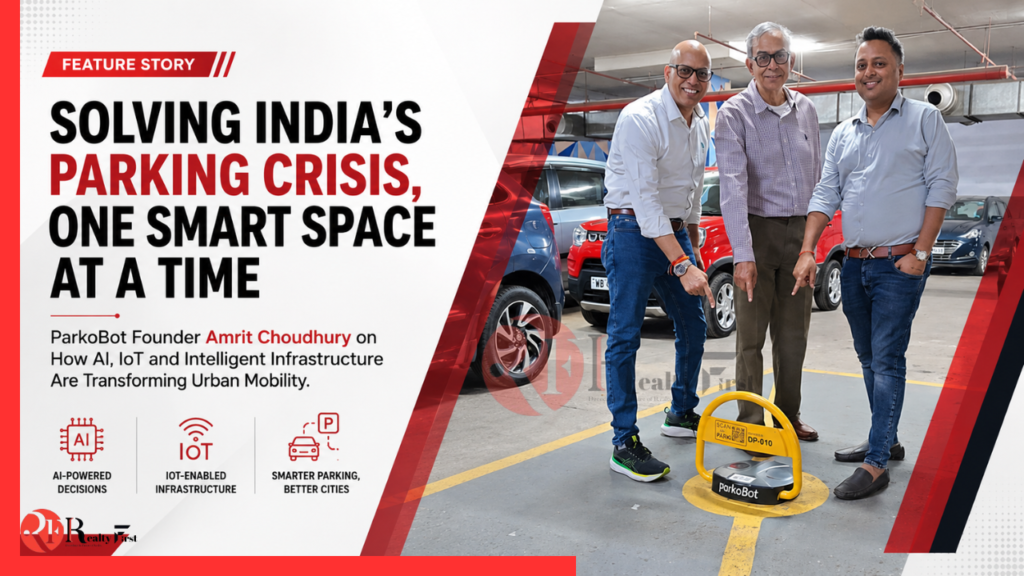
ParkoBot Founder Amrit Choudhury on How AI, IoT and Intelligent Infrastructure Are Transforming Urban Mobility
India’s urban mobility challenges are often discussed in the context of metro rail networks, highways, electric vehicles and public transport. Yet, one of the most persistent causes of congestion continues to receive far less attention, parking. Every day, thousands of vehicles circle busy commercial districts, hospitals, schools and business centres simply searching for an available parking space. At the same time, countless private parking bays remain vacant for hours, creating a paradox where scarcity exists alongside underutilisation.
It is this disconnect that inspired Amrit Choudhury, Founder and CEO of ParkoBot, to rethink parking not as a real estate constraint but as an infrastructure and technology challenge. Founded in 2023, ParkoBot has developed India’s first AI and IoT-powered intelligent parking ecosystem, combining proprietary smart parking hardware with a cloud-based digital platform that enables users to discover, reserve and securely access private parking spaces. The company is also helping commercial property owners monetise underutilised parking assets while contributing to more efficient urban mobility.
In this conversation with Realty First, Amrit Choudhury shares how ParkoBot is building a smarter parking ecosystem and why the future of urban mobility begins with making better use of the infrastructure cities already have.
Also Read: BPTP Begins Allotments for SkyNest Towers After Strong Buyer Response in Greater Faridabad
Q: Most people see parking as a daily inconvenience, but you describe it as an infrastructure problem. What inspired you to rethink parking through the lens of technology?
Amrit Choudhury: The idea actually started almost a decade ago during my previous technology venture. We were working with global companies such as Samsung and Apple, providing enterprise mobility solutions, and I realised that parking was a challenge that technology could solve.
Initially, we approached government agencies to understand whether digitising public parking infrastructure was possible. However, the willingness to modernise systems was limited, and that made us think differently.
Instead of focusing only on public infrastructure, we looked at private parking. That’s when we realised that India’s problem isn’t a shortage of parking spaces, it’s the inefficient utilisation of existing ones. There are thousands of private parking spaces that remain vacant for several hours every day while drivers struggle to find parking nearby.
That insight led us to build what is essentially an Airbnb-style marketplace for parking, where idle private parking spaces can be safely monetised whenever owners are not using them.
Q: How does ParkoBot use AI and IoT to make this model work?
Amrit Choudhury: Technology is the foundation of everything we do.
Our proprietary IoT-enabled Smart Space Lock is installed at each parking space. It operates only through authorised bookings made on the ParkoBot app. Once a booking is confirmed, the lock automatically opens for the registered user, ensuring complete access control without manual intervention.
Artificial Intelligence works alongside this hardware to make parking smarter. Our platform understands the driver’s destination and recommends available parking spaces based on walking distance, traffic conditions and pricing. Users can compare multiple options located at different distances from their destination and choose what best suits their convenience and budget.
We have also integrated navigation with Google Maps and developed our own indoor navigation capabilities for large commercial properties, helping users locate their exact parking space quickly and efficiently.
Ultimately, we are not just helping people find parking, we are helping them save time.
Q: How can commercial property owners benefit from ParkoBot?
Amrit Choudhury: Commercial buildings, office complexes and malls often have hundreds of parking spaces that remain unused during certain hours of the day.
Our platform enables property owners to monetise these idle assets without compromising security or operational control.
We currently focus primarily on commercial properties because residential communities often have their own access restrictions. Instead of allowing unrestricted external access, our residential solution is designed mainly for visitor and guest parking.
For commercial developments, however, the opportunity is enormous. Property owners generate an additional revenue stream, while drivers gain access to organised parking near their destination.
It’s a win-win ecosystem.
Q: Are developers and commercial real estate companies embracing this idea?
Amrit Choudhury: Absolutely.
We’re already working with several leading real estate developers, commercial landlords, REITs and co-working operators. In fact, a few real estate developers have also invested in ParkoBot.
The market increasingly recognises that parking is no longer just an operational necessity, it is an underutilised asset that can generate measurable value through technology.
Q: How do you see smart parking fitting into India’s urban infrastructure initiatives?
Amrit Choudhury: I actually believe parking should not be viewed only through the lens of Smart Cities.
Congestion exists everywhere, from metro cities to temple towns, tourist destinations and rapidly growing Tier II cities.
Our technology is designed around congestion rather than geography.
Whenever a location experiences high parking demand and unused private inventory exists nearby, ParkoBot can create value.
Imagine a busy school where thousands of vehicles arrive every morning while the neighbouring office building has hundreds of vacant parking spaces during the same hours. That’s precisely the gap we solve.
By bringing private parking inventory onto a digital public network, we help reduce roadside parking, improve traffic flow and make cities more efficient without requiring additional land acquisition.
Q: How does the revenue-sharing model work for parking owners?
Amrit Choudhury: Every parking host first installs our Smart Space Lock, which secures the parking space and enables digital access.
Once the parking becomes available, ParkoBot begins listing and monetising it through our platform.
Revenue sharing isn’t fixed because every location has different demand characteristics. Our AI continuously evaluates congestion levels, demand patterns and utilisation before recommending commercial terms.
Parking spaces in high-demand business districts naturally generate greater revenue than those in low-congestion areas.
Rather than manually deciding pricing, we allow AI and market demand to optimise utilisation and maximise returns for hosts.
Q: What has been your biggest challenge while building this ecosystem?
Amrit Choudhury: Technology wasn’t the biggest challenge, changing mindsets was.
People often believe that because a parking space belongs to them, it should remain vacant until they decide to use it, even if it sits unused throughout the day.
I often compare this to the evolution of co-working spaces. Years ago, businesses believed every employee needed a permanently assigned desk. Today, flexible workspaces have become mainstream because people recognise that shared resources create greater efficiency.
Parking is going through a similar transition.
Once property owners understand that an unused parking space is a dormant asset capable of generating revenue, adoption becomes much easier.
Q: Beyond parking, what is the next phase of ParkoBot’s growth?
Amrit Choudhury: Electric vehicle infrastructure is a natural extension of our platform.
One of the biggest barriers to EV adoption is charging accessibility, particularly for commercial fleets and app-based taxi drivers who often lack dedicated parking and charging facilities.
We’re now converting many of our parking locations into overnight EV charging hubs. Drivers will be able to park their vehicles overnight, charge them and return the next morning with a fully charged vehicle.
We’re already working with charging infrastructure companies to expand this network, and we believe smart parking combined with EV charging can significantly accelerate electric mobility across Indian cities.
Q: If you could redesign one aspect of urban mobility using technology, what would it be?
Amrit Choudhury: I would focus on digitising access control for commercial buildings.
We’re already working with government agencies and private organisations to automate entry and exit through AI-enabled access systems.
Removing manual gate operations improves security, reduces waiting time and creates a seamless experience for both property managers and visitors.
When connected with intelligent parking, these systems become part of a much larger urban mobility ecosystem.
ParkoBot’s vision extends well beyond parking management. It represents a broader shift in how cities can optimise existing infrastructure instead of constantly creating new assets. By combining AI, IoT, intelligent access control and digital mobility solutions, the company is demonstrating that many urban challenges can be addressed through smarter utilisation rather than additional construction.
As Indian cities continue to grow, solutions that integrate real estate, mobility and technology will play an increasingly important role in shaping sustainable urban ecosystems. If adopted at scale, intelligent parking could become as fundamental to future cities as smart buildings and connected infrastructure are today.