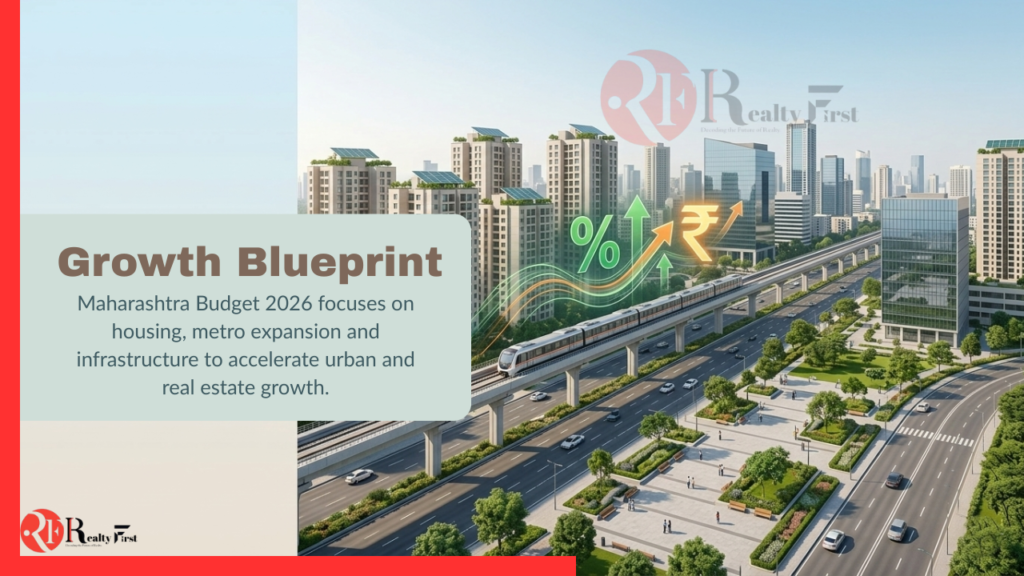
The Maharashtra State Budget 2026, presented by Chief Minister Devendra Fadnavis, has outlined a forward-looking roadmap focused on housing expansion, infrastructure upgrades, and urban development, measures that industry leaders believe will significantly strengthen the state’s real estate ecosystem.
The budget places strong emphasis on affordable housing, mobility infrastructure, and digitization of urban services, while also setting long-term economic and urbanization targets aimed at positioning Maharashtra as a key driver of India’s growth over the coming decades.
Among the major announcements is the completion of 3.57 lakh homes under the Pradhan Mantri Awas Yojana, alongside incentives for rooftop solar installations in residential projects. Industry experts say the move could boost affordability and sustainability in the housing sector while expanding access to home ownership.
Also Read: Mumbai Logs Highest February Registrations in 14 Years; Premium Housing Lifts Stamp Duty 21%
At the same time, the government has committed significant investments towards expanding metro networks, highways, and key urban infrastructure projects across major cities, including Mumbai, Pune, Nashik, and Nagpur. The initiatives are expected to improve connectivity and support the development of emerging residential and commercial corridors.
Real estate industry stakeholders have welcomed the government’s focus on integrated infrastructure and urban planning, noting that improved connectivity often acts as a catalyst for property development and investment.
Prashant Sharma, President of NAREDCO Maharashtra, said the budget reflects a strong commitment towards strengthening the housing and infrastructure sectors.
“The Maharashtra State Budget 2026 outlines a strong and forward-looking vision for the state’s housing and infrastructure sectors. The announcements under the Pradhan Mantri Awas Yojana, including accelerated housing completions and rooftop solar incentives, are particularly encouraging as they will enhance affordability while promoting sustainability. At the same time, the focus on metro expansion and digitized urban management aligns with key real estate growth corridors and will help energize demand and strengthen investor confidence,” Sharma said.
Infrastructure development has emerged as a central theme of the budget, with several major projects aimed at addressing urban congestion and improving mobility across the Mumbai Metropolitan Region.
Kaushal Agarwal, Chairman of The Guardian’s Real Estate Advisory, noted that expanded metro corridors and new transport links could significantly reshape the city’s property landscape.
“The Maharashtra Budget’s strong focus on expanding metro corridors, coastal roads, and signal-free connectivity reflects a long-term vision to ease Mumbai’s chronic congestion and strengthen intra-city mobility. Projects such as the Wadala–Gateway of India underground metro and the airport-to-airport metro link will improve access to South Mumbai while integrating emerging corridors across the city,” Agarwal said.
He added that improved connectivity typically acts as a major catalyst for real estate development, enhancing the attractiveness of multiple micro-markets and supporting more balanced urban growth.
Developers have also highlighted the importance of digitization initiatives announced in the budget, which aim to streamline urban governance and improve service delivery.
According to Shraddha Kedia-Agarwal, Director at Transcon Developers, the emphasis on housing completion and digital urban services addresses key priorities for both developers and homebuyers.
“The state budget’s focus on housing completion and digitized urban services directly supports developer and consumer priorities. Enhanced infrastructure from coastal roads to underground traffic solutions will significantly improve liveability. With targeted development plans for key cities and support for innovation hubs, Maharashtra is creating a conducive ecosystem for sustainable urban expansion and real estate investment,” she said.
The government has also outlined ambitious long-term goals, including expanding metro networks and developing nearly 6,000 kilometers of expressways across the state.
Kamlesh Thakur, Co-Founder and Managing Director of Srishti Group, said the budget reflects a comprehensive strategy to manage rapid urbanization while improving infrastructure and economic opportunities.
“The 2026 state budget takes a comprehensive approach to urbanization and connectivity, with ambitious targets including a 70 percent urban population by 2047, extensive metro expansions, and nearly 6,000 kilometers of expressways. Key projects such as the Goregaon–Mulund Link Road and the Versova–Bhayander Coastal Road will significantly improve urban mobility,” Thakur said.
He added that the government’s focus on job creation, affordable housing completion, and digitized urban services would enhance transparency and efficiency while making Maharashtra a more attractive destination for both homebuyers and real estate developers.
Also Read: Smart Homes: Features Buyers Demand in 2026
Industry observers believe the budget’s emphasis on infrastructure, housing supply, and digital governance could play a key role in sustaining Maharashtra’s position as one of India’s most important real estate and economic hubs.
With the government targeting the creation of more than 50 lakh direct and indirect jobs and aiming to attract higher levels of foreign direct investment, the state is positioning itself for long-term growth as it works toward its broader development vision for 2047.