
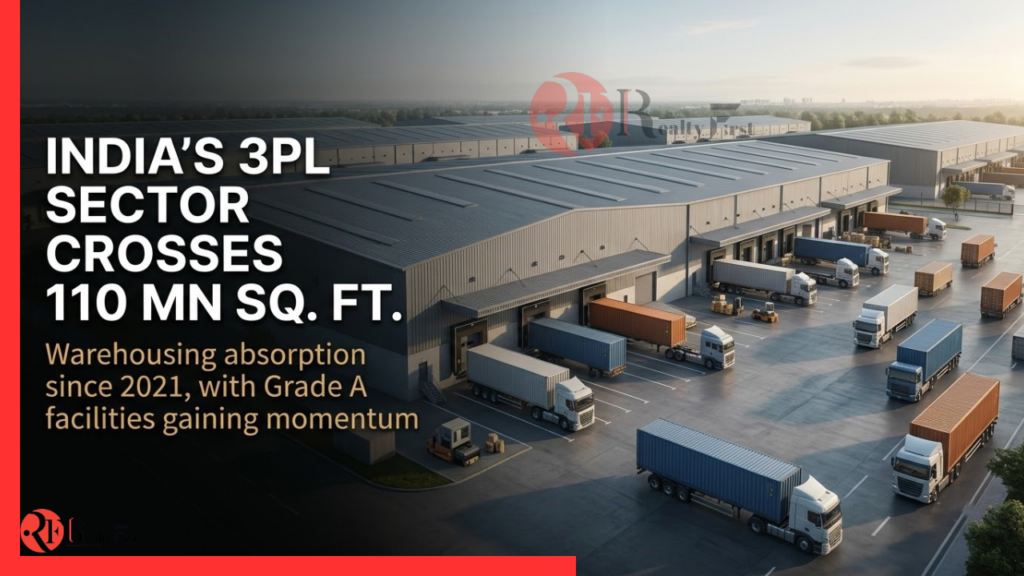
Mumbai: India’s third-party logistics (3PL) sector has emerged as the largest occupier segment in the country’s warehousing market, recording cumulative gross absorption of more than 110 million sq. ft. between 2021 and H1 2026, according to a JLL report titled Beyond the Box: The Future of Real Estate of India’s Leading 3PL Players.
The sector maintained a gross absorption share of 28% to 42% during the period, highlighting sustained demand despite fluctuations in the broader economic environment. In H1 2026 alone, 3PL players accounted for 11.1 million sq. ft. of warehousing absorption.
The market is also seeing a gradual shift towards larger and higher-quality facilities. The share of Grade A warehousing in 3PL transactions increased from 50% in 2021 to 57% in 2025, reflecting a growing preference for institutional-grade infrastructure and facilities capable of supporting technology and automation.
“India’s 3PL sector consistently captures the highest share of gross warehousing demand, thus establishing itself as one of the market’s most consistent growth engines. The 25% expansion in average deal sizes from 100,000 sq. ft in 2021 to 125,000 sq. ft in 2025 is not just about scale; it signals a long-term trajectory of growth and appetite for future-ready infrastructure. This is about India’s manufacturing and logistics sector becoming globally competitive through strategic infrastructure investment that supports automation, sustainability, and technology integration,” said Yogesh Shevade, Managing Director, Industrial & Logistics, India, JLL.
Also Read: 91,729 Homes Sold Across Top 8 Cities in Q2 2026 as Housing Market Remains Resilient
Grade A Warehousing Gains Ground
The increasing adoption of Grade A infrastructure points to a broader change in the requirements of 3PL occupiers. Modern warehouses are increasingly being evaluated for their ability to support operational efficiency, technology integration and automation.
However, the report highlights a structural challenge within the sector. While 3PL customers often seek shorter contractual commitments, they simultaneously expect operators to make significant investments in technology and operational capabilities. This mismatch could constrain the pace of technology adoption across the sector.
The shift towards better-quality infrastructure is also reflected in transaction sizes. Average 3PL deal sizes increased 25%, from 100,000 sq. ft in 2021 to 125,000 sq. ft in 2025. For Grade A facilities, the average transaction size reached 145,000 sq. ft in 2025.
According to the report, the increase in transaction sizes is indicative of network consolidation and a greater focus on quality infrastructure. Larger facilities can support more centralised operations and help improve inventory management across wider service networks.
Grade A Warehousing Commands Higher Rental Growth
Rental trends also point to a growing differentiation between Grade A and overall 3PL facilities.
Overall rents for 3PL facilities increased at a 3.9% Compound Annual Growth Rate (CAGR) between 2021 and 2025, reaching INR 21 per sq. foot. Grade A facilities recorded a higher 4.9% CAGR over the same period, taking rents to INR 23 per square foot in 2025.
The report also identifies a mismatch between prevailing market rents and occupier expectations for 3PL facilities, suggesting that greater equilibrium will be required between landlords and occupiers.
This rental gap became more pronounced in H1 2026. Grade A rents reached INR 23.7 per square foot, representing a 7.7% year-on-year increase and exceeding the pace of growth recorded across the broader market.
The trend indicates that occupiers are increasingly willing to pay a premium for facilities that offer stronger operational capabilities and infrastructure standards.
3PL Demand Remains Structurally Strong
With more than 110 million sq. ft. of cumulative absorption since 2021, 3PL operators have maintained their position as a leading occupier category in India’s warehousing market. Their 28%–42% absorption share across five annual cycles points to sustained structural demand rather than a short-term cyclical trend.
The growth is closely linked to the increasing use of outsourced logistics by e-commerce, quick commerce and manufacturing businesses. However, attracting and retaining trained talent continues to be a significant challenge for 3PL operators.
The report also points to the need for closer coordination among developers, occupiers and 3PL companies. Greater alignment from the planning and construction stages through to warehouse operations could help create more effective infrastructure and improve synergy across the logistics ecosystem.
Also Read: Consumer Intelligence Can Help Developers Identify Genuine Property Buyers
As the sector moves towards larger transactions, higher Grade A penetration and greater technology integration, the evolution of India’s 3PL warehousing market is increasingly being shaped not only by the amount of space absorbed, but also by the quality, efficiency and operational capabilities of that space.