India’s real estate investment landscape is expanding beyond its traditional metropolitan centres, with infrastructure development, improving connectivity and emerging employment hubs bringing Tier-2 cities and smaller economic centres into sharper focus. Yet established markets such as Gurugram continue to attract demand, particularly in locations where new infrastructure is opening up residential and commercial opportunities.
For property investors, the choice between emerging cities and established metros involves more than comparing property prices. Smaller markets may offer lower entry costs and opportunities to participate in early-stage development, while metropolitan markets generally benefit from established rental demand, deeper buyer pools and greater resale liquidity.
Gurugram illustrates how infrastructure development can influence an established property market. The Dwarka Expressway and the expansion of New Gurugram have opened up additional residential catchments and improved connectivity across the National Capital Region (NCR).
Also Read: GCCs Emerge as a Key Driver of India’s Next Office Real Estate Cycle, with 75% Planning Expansion
Ashok Singh Jaunapuria, Managing Director & CEO, SS Group, said, “Dwarka Expressway has moved into a different phase of its development. The 135% price appreciation is a clear indication of how buyer perception has changed as connectivity and infrastructure have improved.
“What is particularly interesting now is the shift in the housing mix. Larger homes and higher ticket sizes are becoming an important part of the market, while the growth of New Gurugram is giving buyers more options beyond the traditional luxury locations. The next phase will be about how well infrastructure, new supply and end-user demand keep pace with the rise in prices.”
Gurugram’s development also illustrates why infrastructure investment does not translate into uniform property appreciation across a city. Locations are more likely to benefit when better connectivity coincides with employment opportunities, residential demand and supporting social infrastructure.
This relationship is becoming increasingly important as investors assess Tier-2 cities and emerging economic corridors. New roads, airports, railway networks and industrial corridors are improving access to locations that were previously distant from major economic centres. However, infrastructure alone may not be sufficient to sustain property growth unless it generates economic activity and translates into actual demand.
Sahil Marshall, CEO, Bhaarat Wealth Group, said the development of economic corridors could create opportunities for investors willing to enter markets at an early stage.
“If the goal of an investor is to create timeless wealth, investing in emerging economic corridors may be one of the most effective ways to capture long-term value. India is laying \~30 km of new roads every day, adding \~2 railway stations every month and \~1 airport every 3 months. New infrastructure creates fresh demand. Fresh demand creates demand-supply mismatches. And those mismatches, when identified early, can ultimately create the kind of multiplier returns investors dream about.
“But new areas are notoriously difficult to understand. Master plans are evolving, demand indicators are scattered, information is fragmented, and there are always players willing to create hype around hollow information. The single biggest deterrent, therefore, is not finding land. It is knowing whom to trust to identify the right opportunity, navigate the complexity and take responsibility for the investment journey.”
The growth of emerging markets is not confined to residential property. Housing demand may emerge first as populations and employment centres expand, followed by opportunities in retail, warehousing and commercial real estate as local consumption and business activity develop. The sequence and pace of this expansion, however, differ from one city to another.
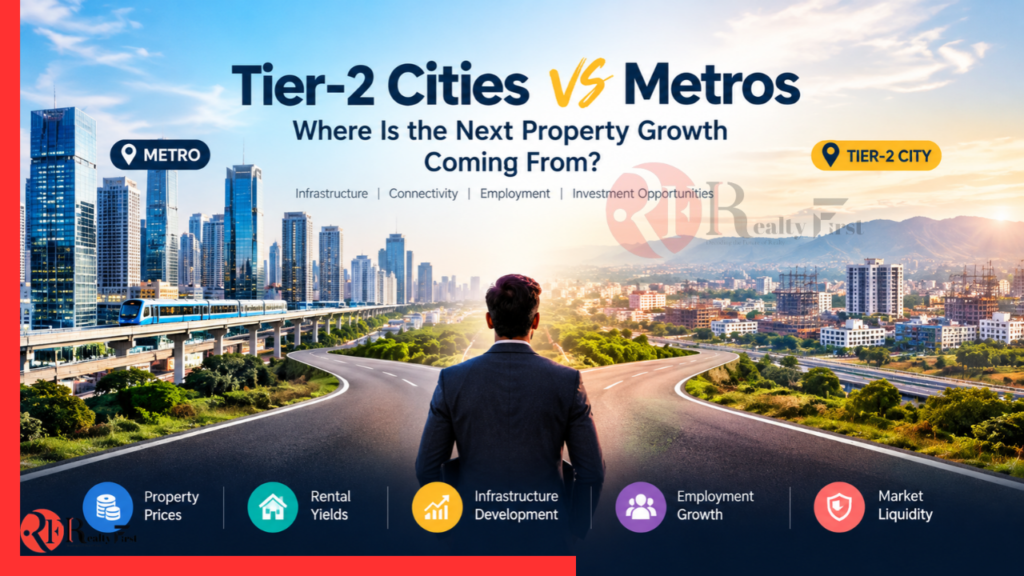
For investors comparing Tier-2 cities with metropolitan markets, headline price appreciation is only one measure of potential returns. Entry costs, rental demand, yields, transaction volumes, infrastructure development, employment growth and resale market depth all influence an investment’s prospects and associated risks.
Khalid Masood, Director, Shalimar Corp, said, “Tier-2 and emerging cities are seeing stronger real-estate interest as infrastructure improves, local economies expand and new employment centres develop beyond the traditional metros. Residential is likely to remain a key demand driver, while warehousing, retail and commercial spaces can benefit where there is sustained economic activity.
“For investors, the comparison with metros should go beyond headline price appreciation. Entry cost, rental demand, yield, infrastructure, liquidity and the depth of the local market all need to be considered. In emerging markets, investors should also examine employment growth, connectivity, planned infrastructure, absorption levels and the credibility of developers, while keeping in mind that smaller markets can carry higher liquidity and resale risks.”
Market depth remains a significant distinction between emerging locations and established metropolitan centres. A property in a smaller city may have a lower purchase price, but a limited pool of prospective buyers and tenants can make resale more difficult. Established markets may command higher valuations, yet typically offer a broader base of end users, investors, tenants and developers.
Investors must also distinguish between infrastructure projects at different stages of development. Announcements and proposed corridors can influence market sentiment, but their effect on property values depends on execution and the economic activity they generate. Operational infrastructure and projects under active development therefore warrant a different assessment from proposals that remain at the planning stage.
Other considerations include developer credibility, land ownership and title, regulatory approvals, existing supply, absorption rates and the strength of the surrounding employment ecosystem. These factors can be particularly important in smaller markets, where a shallower property market may amplify liquidity risks.
The evolving picture does not necessarily point to a shift away from metropolitan markets. Instead, it suggests that India’s real estate investment landscape is broadening, with established cities continuing to offer economic depth and liquidity while infrastructure-led corridors in smaller cities create opportunities as their underlying economies expand.
Also Read: How Vadhavan Port Could Shape Vasai’s Residential Real Estate Market
For investors, the central consideration is not whether Tier-2 cities are inherently better than metros, but where infrastructure development, employment opportunities and sustainable property demand are converging.